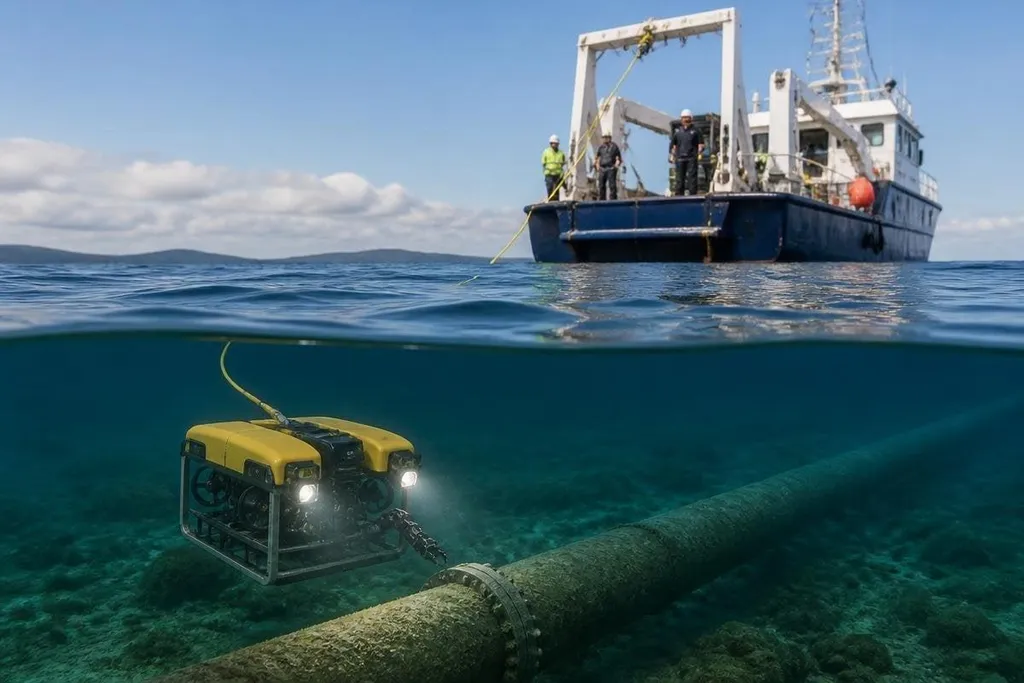
An underwater robot can inspect a pipe, map the seabed, or check a ship without putting a person in the water. Its next phase will depend less on new shapes and more on three hard limits: power, pressure, and communication.
- Tethered robots will keep handling live inspection and repair work.
- Autonomous robots will need better plans for poor visibility and lost signals.
- Maintenance teams will judge them by useful work per dive, not demo length.
Two types, two working styles
A remotely operated vehicle, or ROV, gets power and commands through a cable. That link lets an operator watch video, change the route, and control a manipulator while the robot works below the surface.
An autonomous underwater vehicle, or AUV, carries its own battery and follows a plan stored in its computer. It can cover an area without a live control link, then return with its data. The trade-off is clear: once an AUV loses contact, the team has fewer ways to correct a mistake.
Both designs will remain useful because underwater work has different needs. A cable suits inspection beside a ship or offshore structure. An AUV suits survey work across a wide area where dragging a cable would slow the job.
The hard limits below the surface
Water changes how robots sense and communicate. GPS signals do not travel through seawater, so an underwater robot cannot rely on the same location system used by a drone or road vehicle. It must estimate its position with sonar, inertial sensors, depth sensors, or a mix of these tools.
Sonar sends sound through the water and reads the returning signal. It can work in darkness, but the result depends on range, water conditions, and the shape of the object. Cameras give a more familiar view, yet light fades with depth and suspended particles can block the image.
Power creates a second limit. Motors, lights, computers, sonar, and pumps all draw from the same battery or cable supply. A robot that spends more energy fighting currents has less time for inspection, which makes route planning part of the job rather than a software detail.
Pressure adds a physical risk. The force on a sealed housing rises as the robot goes deeper, so a design that works in shallow water may need a different housing, connector, and test plan for deeper work. One failed seal can end a dive before the robot reaches its target.
Where the next gains are likely
The useful progress will come from better cooperation between the robot and the team on the surface. An AUV could follow a planned survey, flag a damaged section, and send a small data package when it reaches a point where communication works. An operator could then change the next route instead of controlling every movement.
That approach also limits the damage from a broken link. The robot needs a safe behavior for lost contact, such as holding position, rising to a set depth, or returning along its planned route. The right choice depends on current, depth, battery level, and the risk of striking an object.
An underwater inspection result needs the vehicle, depth, sensor, and date beside it. Reports on Robot24.com can tie those facts to named machines and tests, so you can tell if a claim came from a tank or open water. That context matters when the robot’s images need to support checks after the dive.
The next step is better data after the dive. A robot that records where each image came from can give an inspection team a repeatable record. That lets people compare the same pipe, hull, or seabed section over time and spot changes earlier.
Still, nobody has shown that one underwater robot can handle every setting. A machine built for clear water near a dock may struggle in silt, strong current, or deep water. A system that works without a cable may also carry less lifting power because its battery must supply the whole mission.
A buying checklist for underwater work
Before choosing a robot, check these points:
- State the task: Decide if the job needs video, sonar mapping, sample collection, or physical repair.
- Set the depth: Match the rated depth to the work site, with room for bad weather or a route change.
- Check the link: Confirm how the robot receives commands and what it does after contact is lost.
- Count the work time: Measure useful inspection time after travel, setup, launch, and recovery.
- Plan recovery: Set out how the team will find and retrieve the robot after a fault.
- Check the data: Make sure images, sonar records, and location data can move into the team’s existing system.
The best future system may be a pair: an ROV for close work and an AUV for wide surveys.
I'd choose the design that reduces people’s exposure to the water while keeping a clear recovery plan, even if it covers less ground per dive. The deciding number will be useful inspection hours between launches, not the robot’s maximum depth on paper.